 Open Middle®
Directions: Using the digits 0 to 9, at most one time each, create five ordered pair that represent a linear function that has a greater rate of change than the following:
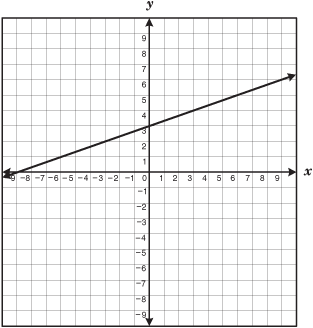
(___,___) (___,___) (___,___) (___,___) (___,___)
How many different ones are there?
Hint
What information tells you about the rate of change?
Answer
4, they are:
f(x)= {(0,1),(2,3),(4,5),(6,7),(8,9)}
f(x)= {(1,0),(3,2),(5,4),(7,6),(9,8)}
f(x)= {(0,5),(1,6),(2,7),(3,8),(4,9)}
f(x)= {(5,0),(6,1),(7,2),(8,3),(9,4)}
f(x)= {(0,1),(2,3),(4,5),(6,7),(8,9)}
f(x)= {(1,0),(3,2),(5,4),(7,6),(9,8)}
f(x)= {(0,5),(1,6),(2,7),(3,8),(4,9)}
f(x)= {(5,0),(6,1),(7,2),(8,3),(9,4)}
Source: Bryan Anderson
I love this task! It really gets as the question of what rate of change is and comparing rates of change.
Question: Does a correct solution need to be able to use all 10 numbers? If we are only asked to find 4 ordered pairs, couldn’t (1,2) (3,4) (5,6) (7,8) also fit? Sure, the y-intercept does not fit the parameters of the task, as it would be (0,1), but since we are only asked to find 4 ordered pairs, could this also be a solution?
Thank you for all that you do and all of your thinking to come up with such great tasks!
Sorry Nicole, that was a typo. If you look at the solution set, I listed 5 ordered pairs. I will correct the mistake.
(although I would say yes, using only 4 points the outline was to not use any number twice- disregarding other points that lie on the line. Using only 4 points should open up the number of solutions as well.)
I don’t understand how to solve this problem. Could you please explain? Can you use more than one line with the same slope?
I don’t think so, lines with the same slope needs the same digit.