 Open Middle®
Directions: Using the digits 1 to 9, at most one time each, place a digit in each box to make a whole number product.
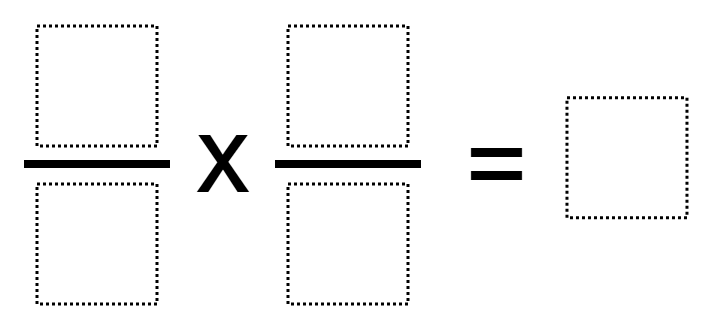
Hint
How can you use equivalent fractions to find the answer?
Answer
There are many possible answers. One example is 2/1 x 9/6 = 3.
Source: Owen Kaplinsky
My students came up with more solutions:
2/1 X 9/6 = 3
4/1 X 6/3 = 8
6/4 X 2/3 = 1
3/2 X 6/9 = 1
4/2 X 3/1 = 6
3/6 X 4/2 = 1
2/3 X 9/6 = 1
4/8 X 6/3 = 1
9/3 X 4/2 = 6
I did 2/1 times 9/6=3
I had 6/2 x 3/1 = 9. I got this by finding a number that times by something would be under ten. I first got 6/2 and that got me 3. Then i got 3 from 3/1. Lastly i multiplied 3 by 3 and got 9. I agree it was a challenging puzzle.
I got 8/1 x 6/2 = 21
This is not what I was looking for please be more accurate with the answers I really HATE it when I get the answers wrong. 🙁
2/3×1/3=3/3 or 1
2/3 x 1/3 is 2/9, not 1.
I don’t agree with the first two provided answers. If you use a unit fraction as a factor, you cannot reuse the “1” tile in the answer. In fact, I don’t think there is an answer with a unit fraction as a factor. The third supplied answer works, though.
I got 8/6 x 3/4=1. Im 10! This is not really 5th grade level if you know how to multiply fractions.
Today we found:
9/6 x 2/3 = 1
6/9 x 3/2 = 1
6/3 x 2/4 = 1
6/8 x 4/3 = 1
4/6 x 3/2 = 1
1/8 x 4/3 = 6
6/4 x 8/3 = 2
The 24 unique solutions are
2/3 * 6/4 = 1
2/3 * 9/6 = 1
3/4 * 8/6 = 1
3/6 * 4/2 = 1
3/9 * 6/2 = 1
4/8 * 6/3 = 1
3/6 * 4/1 = 2
3/9 * 6/1 = 2
4/3 * 9/6 = 2
2/4 * 6/1 = 3
2/6 * 9/1 = 3
4/6 * 9/2 = 3
4/8 * 6/1 = 3
8/6 * 9/4 = 3
2/1 * 6/3 = 4
3/6 * 8/1 = 4
8/6 * 9/3 = 4
2/1 * 9/3 = 6
3/2 * 4/1 = 6
3/4 * 8/1 = 6
4/2 * 9/3 = 6
8/4 * 9/3 = 6
4/3 * 6/1 = 8
3/1 * 6/2 = 9
You can always swap the fractions, the numerators or the denominators to get another solution.
This is a good open ended question. It would be useful to have it show up when you search reciprocal, as so many of the solutions work because of reciprocals. In our class, we used it to reinforce the concept that the multiplication of reciprocals always equals 1.