 Open Middle®
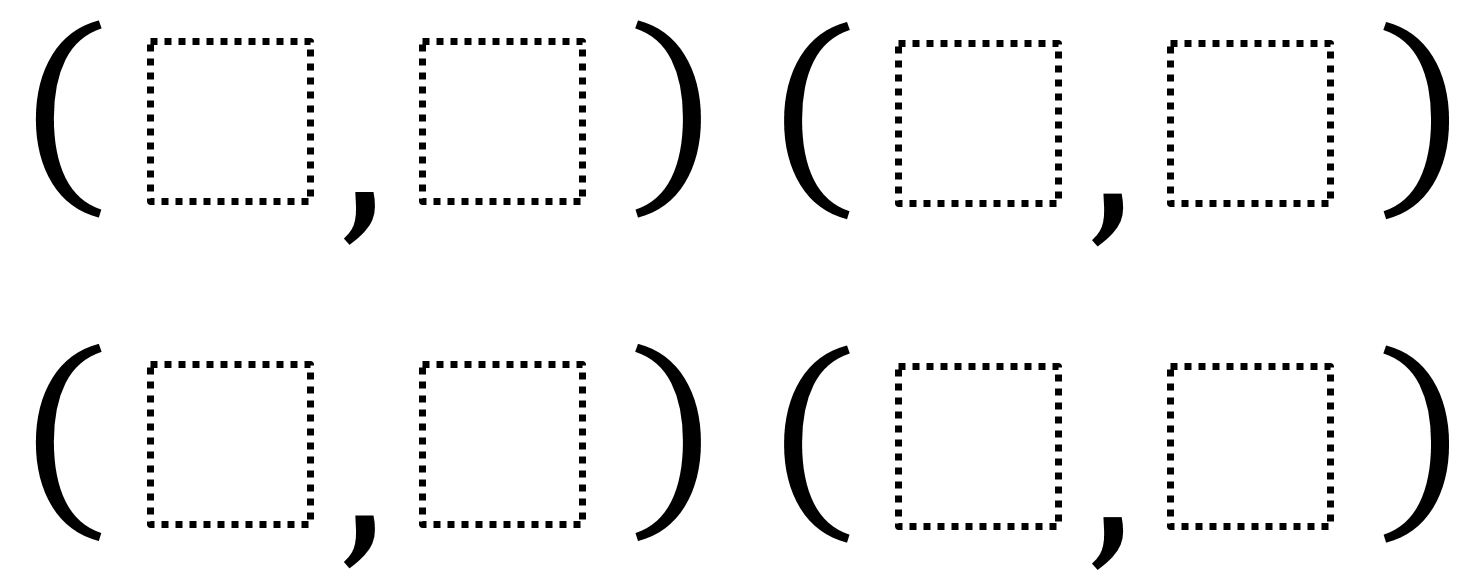
Directions: Using the digits 1 to 9, at most one time each, place a digit in each box so that the points make a parallelogram.
Hint
What do you know about a parallelogram that would help you with this problem?
Which points need to be connected to make parallel sides?
Which points need to be connected to make parallel sides?
Answer
There are 696 unique solutions. Three examples are:
(1,2),(3,5),(6,4),(8,7)
(1,2),(3,6),(7,4),(9,8)
(1,2),(4,3),(6,7),(9,8)
(1,2),(3,5),(6,4),(8,7)
(1,2),(3,6),(7,4),(9,8)
(1,2),(4,3),(6,7),(9,8)
Source: Daniel Torres-Rangel
I only found eight possible solutions, but I’m willing to be wrong.
All are transformations of the first solution given – reflect it over the midline (y = 4.5) for another, over the other midline (x = 4.5) and across the line y = x. This gives you four solutions that all have rotational symmetry with each other about a circle centered at (4.5, 4.5).
To get the other four solutions translate the first four solutions by the vector .
Very cool Kevin. Thanks for sharing your approach.
(1,7)
(6,5)
(3,4)
(8,2)
How were all 696 solutions found? Brute force, algorithm, or some other way? I’m also curious if there is a way to prove that there are 696 unique solutions without actually finding them.
A computer program I wrote in Java found the set of solutions.
I found #39 very helpful because it made a rectangle, and I found at another source that said a rectangle is a special kind of parallelogram. I would like to say that I believe that not all those answers are correct on a coordinate plane but I found one so I am happy!
The areas of these parallelograms are all in the range [1,29]
Ex: #33: (1,6),(2,7),(4,8),(5,9) –> area=1
#106: (2,6),(4,1),(7,8),(9,3) –> area=29
Between these parallelograms there are five different squares.
* area=5 Ex #40: (1,7),(2,9),(3,6),(4,8)
* area=17 Ex #44: (1,7),(5,8),(2,3),(6,4)
* area=20 Ex #163: (3,2),(1,6),(7,4),(5,8)
* area=26 Ex #68: (2,3),(1,8),(7,4),(6,9)
* area=29 Ex #106: (2,6),(4,1),(7,8),(9,3)
Beyond these squares there are five other different rectangles.
* area=4 Ex #39: (1,7),(2,8),(3,5),(4,6)
* area=8 Ex #17: (1,4),(5,8),(2,3),(6,7)
* area=10 Ex #21: (1,4),(6,9),(2,3),(7,8)
* area=16 Ex #18: (1,4),(5,8),(3,2),(7,6)
* area=20 Ex #75: (2,3),(6,9),(4,1),(8,7)
And beyond the five squares there are another five different rhombuses.
* area=3 Ex #298: (4,8),(3,6),(2,7),(1,5)
* area=12 Ex #63: (2,1),(6,3),(4,5),(8,7)
* area=15 Ex #47: (1,8),(2,4),(5,7),(6,3)
* area=21 Ex #59: (1,9),(6,7),(3,4),(8,2)
* area=24 Ex #60: (1,9),(6,8),(2,4),(7,3)